 Guest
Guest
Chapter:
1. Figure below shows cross section of a tank full of water under pressure. The length of tank is 2m. An empty cylinder lies along length of tank on one of its corner as shown in figure. Find vertical and horizontal components of force acting on curved surface ABC of cylinder.

SOLUTION:
Given,
Radius of the cylinder,`R=1 m`
Length,`l=2m`
Gauge Pressure,`P=0.2 (kg_f)/(cm)^2`
`=0.2**9.81**10^4`
`P=1.962**10^4`N/`m^2`
And pressure head,`h=P/(rho*g)=(1.962**10^4)/(9810)`
`h=2 m`
Thus the free surface of the tank will be at a height of 2m from the top of the tank.
This free surface is known as imaginary free surface.
Figure below shows the equivalent free surface of water.

Now,
The total horizontal component of force acting on the curved surface ABC of the cylinder is equal to the force on the projected area of the curved surface on the vertical plane
I.e,
`F_x=rho*g*A*bar (h)`
Where,
`bar (h)=`distance of the c.g of the area from free water surface
`bar (h)=(2+1.5/2)`
Thus,
`F_x=9810**(1.5**2)**(2+1.5/2)`
`F_x=80932.5N`
Also, the vertical component of the force is,
`F_y=`weight of water enclosed by the curved surface upto the free surface (real or imaginary )
`F_y=` weight of water in portion `CODEABC`
`=`Weight of water in CODFBC - Weight of water in AEFB
But,
Weight of water in CODEFBC = Weight of water on [COB + BFDOB]
`=rho *g ((pir^2)/2+BO**OD)*Wi dth `
`=9810(pi/4*1^2+1**2.5)**2`
`=64458.5 N`
Again, the weight of water in AEFB = Weight of water in [AEFG + AGBH - AHB]
`=rho g*2(2BH+0.5BH-AHB)`
From figure,
`sintheta=(AH)/(AO)=0.5/1=0.5`
And, `BH=BO-HO=1-AO*cos30`
`BH=1-1cos30=0.134`
And the area of `triangle ABH`=Area of [ABO - AHO]
`=pir^2*30/360-(AH**HO)/2`
`=(pir^2)/12-(0.5**0.866)/2`
`=0.0453`
Thus using all these values,we get,
Weight of water in AEFB `=9810**2 (2**0.134+0.134**0.5-0.0453`
`=5684 N`
Hence,
`F_y=64458.5-5684=58774.5 N`
2. Find resultant force on surface ABCDEF of 10 m width of surface shown below.

SOLUTION:
Given,
Width,`=2m`
Gauge Pressure,`P=-117.72 KPa`
Thus pressure head,`h=P/(rho*g)=-117.72/(1.2**9.81)`
`h=-10 m`
Thus the free surface of the tank will be at a height of 10m further below the top of the given oil surface.
This free surface is known as imaginary free surface.
Figure below shows the equivalent free surface of water.

Now,
The total horizontal component of force acting on the curved surface ABCDEF is equal to the force on the projected area of the curved surface on the vertical plane
I.e,
`F_x=rho*g*A*bar (h)`
Where,
`bar (h)=`distance of the c.g of the area from free water surface
`bar (h)=(3+2+2**1.6)/2=4.10 m`
and projected area,`A=(3+2+2**1.6)**10=82 m^2`
Thus,
`F_x=1.2**9.81**82**4.10`
or,`F_x=3957.7 KN->`
and this acts at a distance of,
`h^**=(I_G sin^2theta)/(A*bar (h))`
`I_G=`moment of inertia
`I_G=(10**8.2^3)/12=459.47 m^4`
Thus`I_G=459.47/(82**4.10)+4.10`
`=5.47 m` from the imaginary surface.
Vertical force
In portion C'D = 0 KN
In portion DD',
`F_(y1)=rho*g*10*Area`
`=9.81**1.2**3**2**10`
`=706.32 KN`(downward)
In portion D'E =0 KN
In portion EF,
`F_(y2)=rho*g*h*Area`
`=9.81**1.2**10**pi**1.6^2/2`
`=473.38 KN`(upward)
Thus, the net vertical force is,
`F_y=473.38-706.32+0`
`=232.94 KN`(Downward)
3. A square aperture in vertical side of a tank has one diagonal vertical and is completely covered by plane plate hinged along one of upper sides of aperture. The diagonals of aperture are 2.4 m long and tank contains a liquid of specific gravity 1.2. The centre of aperture is 1.8 m below free surface. Calculate:
- thrust exerted on plate by liquid
- position of its centre of pressure
[ANNA UNIVERSITY ]
SOLUTION:
![A square aperture in the vertical side of a tank has one diagonal vertical and is completely covered by the plane plate hinged along one of the upper sides of the aperture. The diagonals of the aperture are 2.4 m long and the tank contains a liquid of specific gravity 1.2. The centre of aperture is 1.8 m below the free surface. Calculate:\r\n\r\n<ul>\r\n\r\n<li> the thrust exerted on the plate by the liquid</li>\r\n\r\n<li> the position of its centre of pressure</li>\r\n\r\n</ul>\r\n[ANNA UNIVERSITY ]](/img-uploads/1579773269.jpg)
Given,
Diagonal of aperture,PR=QS= 2.4 m
Area of square aperture, A= area of `triangle`PQR + area of `triangle`PSR
`A=2**1/2**2.4**2.4/2`
`A=2.88 m^2`
Now, the thrust exerted on the plate by the liquid is,
`F=rho*g*A*bar (h)`
`=1.2**1000**9.81**2.88**1.8`
`F=61026.05 N`
Again,
And the point of application of this force is,
`h^** =I_G/(A*bar (h))+bar (h)`
Where,
`I_G=`moment of inertia of aperture PQRS about the diagonal PR
=M.I of `triangle`PQR+M.I of `triangle`PSR about PR
`=(2.4**(1.2)^3)/12+(2.4**1.2^3)/12`
`=0.6912 m^4`
Thus,
`h^**=0.6912/(2.88**1.8)+1.8`
`h^**=1.933 m`
4. An inclined rectangular sluice gate AB 1.2 m by 5 m size shown in figure is installed to control discharge of water. The end A is hinged. Determine force normal to gate applied at B to open it. [A.M.I.E, Summer,1980]
SOLUTION:
Given,
![An inclined rectangular sluice gate AB 1.2 m by 5 m size shown in the figure is installed to control the discharge of water. The end A is hinged. Determine the force normal to the gate applied at B to open it. [A.M.I.E, Summer,1980]](/img-uploads/1579779790.jpg)
Size of the gate = 1.2 m ** 5 m
Area of the gate, `A=1.2**5=6 m^2`
Now,
The depth of C.G of the gate from free water surface is,
`bar (h)=5-(BG*cos45)`
`=5-(AB)/2cos45`
`=5-(1.2/2*1/root ()(2))`
`bar (h)=4.576 m`
Now, Total pressure force acting on the gate is,
`P=rho*g*A*bar (h)`
`=(1000**9.81**6**4.576)/1000`
`=269.3 KN`
Let, this force acts at a depth of `h^**`.
`h^**=(I_G sin^2theta)/(A*bar (h)+bar (h)`
`I_G=`moment of inertia
`I_G=(b*d^3)/12=(5**1.3^3)/12=0.72 m^4`
Thus,
`h^**=(0.72sin^2theta)/(6**4.576)+4.576`
`=4.589 m`
Now, taking moments about hinge A,we get,
`P**AC-F**1.2=0`
or,`269.3**AC=F**1.2`
From figure,
`AC=AB-BC`
`=AB-(OB-OC)`
`=AB-(5/(sin45)-(h^**)/(sin45))`
`=1.2-(5/(sin45)-4.589/(sin45))`
`=0.618`
Thus,
`F=(269.3**0.618)/1.2`
`F=138.69 KN`
5. A 6 m ** 2 m rectangular gate is hinged at base and is inclined at an angle of 60° with horizontal. The upper end of gate is kept in position by a weight of 60 kN acting at angle of 90° as shown in figure. Neglecting weight of gate, find level of water when gate begins to fall.

SOLUTION:
We know, the pressure force on the gate is,
`F=rho*g*A*bar (h)`... (i)
Now,
Area of gate,`=6**2=12m^2`
Now,
Length of gate submerged in water = AD
From figure,
`AC=AD*sin60`
or,`AD=(AC)/(sin60)`
`AD=2/(root ()(3))*h`
Now, the area of the gate immersed in water is,
`A=AD**WIDTH`
`A=2/(root ()(3))*h*2`
`A=4/(root ()(3))*h`
Also,depth of C.G. of the immersed area is,
`bar (h)=h/2`
Thus,the pressure force on the gate is,
`F=rho*g*A*bar (h)`
`=9.81**1000**4/(root ()(3))*h*h/2`
`F=19620/(root ()(3))*h^2`
Also,
`h^**=(I_G sin^2theta)/(A*bar (h))`
Where,`I_G=`moment of inertia
`I_G=(b*(AD)^3)/12`
`=2/12*(2/(root ()(3))*h)^3`
`I_G=(4h^3)/(9root ()(3))`
Thus,
`h^**=((4h^3)/(9root ()(3))*(root ()(3)/2)^2)/((4h)/(root ()(3)*h/2)+h/2`
or,`h^**=(2h)/3`
Also, the distance of centre of pressure from the hinge along the length of the gate` = AE`
We know,
`h-h^**=AE*sin60`
or,`AE=(h-h^**)/(sin60)`
`=(h-(2h)/3)/(root ()(3)/2)`
`=(2h)/(3root ()(3))`
Now taking the momentum about the hinge,
`60000**6-F**AE=0`
or,`60000**6=19620/(root ()(3))*h^2*(2h)/(3root ()(3))`
or,`h=4.36 m`
Note: This type of problem can be solved easily by plotting pressure diagram as explained in next problem.
6. A gate supporting water takes form of an inclined shield which swings around a hinged axis O as shown in figure.Determine:
- The position x of hinge at which a water level of h = 5.1 m on left would cause gate to tip over hinge.
- The magnitude of hydrostatic free on gate just before it opens (tips about hinge) automatically
Neglect frictional effects.
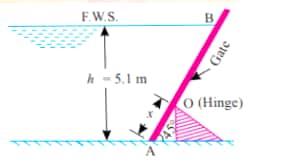
SOLUTION:
The gate would tip about the hinge point O when the line of action of the resultant pressure force lies from O to B anywhere on the gate; the limiting condition being the situation when the resultant force passes through the hinged point O. Hence for the given condition point O becomes the centre of pressure.
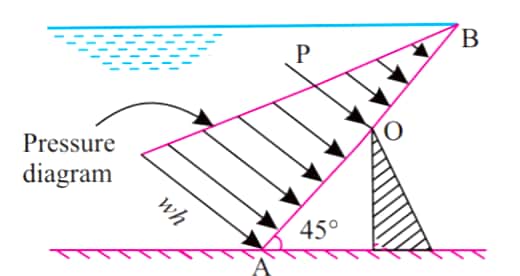
The resultant also passes through the centroid of the pressure diagram, and the centroid lies at a distance `1/3** (AB) ` from the bottom point A.
Thus,
`x=â??*(AB)`
or, `AB=3*x`... (i)
Also,
`h=AB*sin45`
or,`h=3*x*sin45`
or,`h=2.4 m`
Now, the hydrostatic pressure force P is,
P = area of pressure diagram ** width of gate.
Assuming unit width of the gate,
`P=(1/2 *AB*wh*h)*1`
`=180.11 KN`
7. A cylindrical gate of 4m diameter 2m long has water on its both sides as shown in figure. Determine magnitude, location and direction of resultant force exerted by water on gate. Also find least weight of cylinder so that it may be lifted away from floor.

Solution:
Here the force acting on the left sides of the cylinder are,
horizontal component of force `F_(x1)`= force on the projected vertical area AOC
` =rhog*A*bar (h)`
`=9810**(4**2)**2`
`=156960 N`
and this acts at a distance of,
`(h_1)^**=(I_G sin^2theta)/(A*bar (h))`
`=(2**4^3)/(12**4**2**2)+2`
`=2.67 m` from free surface (point A)
Similarly,Vertical force is,
`F_(y1)=`weight of water enclosed by the ABCA
`F_(y1)=rhog*Area**L`
`=9810**2**(pi*2^2)/2`
`=123276.1 N`
Which acts at a distance,
`=(4r)/(3pi)=0.8488m`
Similarly the forces acting on the right side of the cylinder are,
horizontal component of force `F_(x2)`= force on the projected vertical area AOC
` =rhog*A*bar (h)`
`=9810**(2**2)**2/2`
`=39240 N`
and this acts at a distance of,
`(h_2)^**=(I_G sin^2theta)/(A*bar (h))`
`=(2**2^3)/(12**2**2**1)+1`
`=1.33 m` from free surface (point A)
Similarly,Vertical force is,
`F_(y2)=`weight of water enclosed by the COD
`F_(y2)=rhog*Area**L`
`=9810**2**(pi*2^2**90/360)`
`=61638.05 N`
Which acts at a distance,
`=(4r)/(3pi)=0.8488m`
Now, Resultant force in X-direction is,
`F_x=15690-39240` (force acts towards each other. So one is taken as positive and another is taken negative)
`=117720 N`
Similarly Resultant force in Y-direction is,
`F_y=123276.1+61638.05` (both are positive since acting upward )
`=184914.15 KN` (upward)
Thus, Resultant force,
`F=root ()(F_x^2+F_y^2)`
`=219206 N`
And, `theta=tan^-1 (F_y/F_x)=57^0` with the X-axis.
Taking moment about C,
`F_x*y=F_(x1)*(4-2.67)-F_(x2)*(2-1.33)`
or,`y=1.55 m` from bottom.
Similarly,
`F_y*x=F_(y1)**0.8848-F_(y2)**0.8848`
`x=0.282 m` from AOC.
we know, the resulting force in upward direction is,
`F_y=184914.15 N`
Thus the weight of the cylinder should not be less than the upward force `F_y`. Hence the least weight of the cylinder should be at least equal to `184914.15 N`
8. There are two pipes in a system connected by a double U-tube manometer as shown in Figure 1.29 where brine pipe is connected to a tank filled with different fluids. Oil and brine are flowing in parallel horizontal pipelines. The pressure at center of oil pipe is 200 kPa. Take density of water is 1000 kg/m³. a) Write pressure balance equation between points 1 and 2. b) Find pressure at point 2. c) Write pressure balance equation between points 2 and 3. d) Find pressure of point 3.

a) Write the pressure balance equation between points 1 and 2
`P_1+rho_0 g (0.5)-rho_m g(0.1)-rho_a g (0.6)+rho_B g (0.5)=P_2`
b) Find the pressure at point 2
`200** 1000+850**9.81**0.5-13600**9.81**0.1-1**9.81**0.6+1100**9.81**0.5=P_2`
or, `P_2=196217.3` Pa
c) Write the pressure balance equation between points 2 and 3
`196217.3+1100**9.81**0.1-13600**9.81**0.3-1000**9.81**0.3=P_3`
or, `P_3=154328.6` Pa
9. A 3.6 m square gate provided in an oil tank is hinged at its top edge. This tank contains gasoline (s=0.7) upto a height of 1.8 m above top edge of plate. The space above oil is subjected to a negative pressure of 8250 N/`m^2`. Determine necessary vertical pull to be applied at lower edge to open gate. [GATE]
SOLUTION:
![A 3.6 m square gate provided in an oil tank is hinged at its top edge. This tank contains gasoline (s=0.7) upto a height of 1.8 m above the top edge of the plate. The space above the oil is subjected to a negative pressure of 8250 N/`m^2`. Determine the necessary vertical pull to be applied at the lower edge to open the gate.\r\n[GATE]](/img-uploads/1579781554.jpg)
Here, head of oil equivalent to negative pressure of 8250 N/`m^2` is,
`h=p/(rho*g)`
`=8250/(0.7**9810)`
`=1.2 m`
This negative pressure will reduce the oil head above the top edge of the gate from 1.8 m to 1.2 m i.e by 0.6 m.
This free surface is known as imaginary free surface.
Now, the distance of centroid of plate from the free surface is,
`bar (h)=0.6+(3.6/2*sin45)`
`bar (h)=1.873 m`
And,
Area,`A=3.6**3.6=12.96 m^2`.
The pressure force is,
`P=rho*g*A*bar (h)`
`=700**12.96**9.81**1.873`
`=166690N`
Let, this force acts at a depth of `h^**` from the imaginary surface.
`h^**=(I_G sin^2theta)/(A*bar (h)+bar (h)`
`I_G=`moment of inertia
`I_G=(b*d^3)/12`
Thus,
`h^**=((3.6**3.6^3)/12*sin^2(45))/(12.96**1.873)+1.873`
`h^**=2.16 m`
Now, taking moments about hinge A,we get,
`F**3.6sin45=P**(2.16-0.6)/(sin45)`
or, `F=144465 N`
This is the vertical force to be applied at the lower end of the gate to open the gate.
10. A circular opening 3m in diameter in a vertical side of a tank is closed by a disc of 3m diameter which can rotate about a horizontal diameter. Calculate:
- force on disc
- torque required to maintain disc in equilibrium in vertical position ehen head of water above horizontal diameter is 4m
SOLUTION:
Given,
Diameter of circular opening, `d=3 m`
Thus area, `A=(pi*d^2)/4=7.068 m^2`
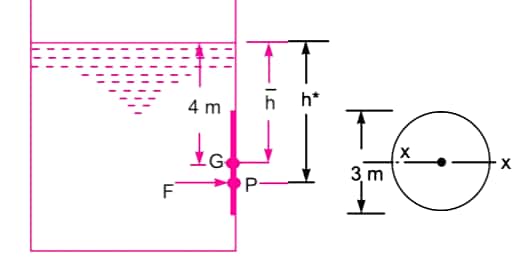
Depth of centre of gravity, `bar (h) =4 m`
Thus, the force on the disc is,
`F=rho*g*A*bar (h)`
`=1000**9.81**7.068**4`
`F=277368 N`
And the point of application of this force is,
`h^** =I_G/(A*bar (h))+bar (h)`
Where,
`I_G=`moment of inertia of the disc through it's centre of gravity.
For circular disc,
`I_G=(pi*d^4)/64`,
Thus,
`h^**=((pi*d^4)/64)/((pi*d^2)/4*bar (h))+bar (h)`
`=pi* d^2/(16**4)+4`
`h^**=4.14 m`
Thus the force acts at a distance of 4.14 m from the free surface of water. Now, taking moment of this force (i.e, torque) about a horizontal diameter, we get,
`=F*(h^** - bar (h))`
`=277368**(4.14-4)`
`=38831 Nm`
Hence, a torque of 38831 Nm must be applied on the disc in clockwise direction to maintain the disc in equilibrium position.
All Chapters
Dimensional Analysis, Similitude and Physical Modelling
Flow Past Through Submerged Body
Boundary Layer Theory
Properties of fluid
- properties of fluids
- complete IOE solution on fluid mechanics
- Detailed description chapterwise
- Unlimited Numericals problem solved with updation daily
- And much more
Hydrostatics
- Hydrostatics basic theory
- All important Numericals
- IOE,PU, MIT,A.M.I.E,Delhi university,EUPS,Engineering service exam solved problems
- Detailed explanation
Hydrostatics- Buoyancy and metacentric height
- detailed explanation of force of buoyancy, metacentric height,stability of floating body
- unlimited numericals solved with updation weekly
- including IOE , PU, KU, GATE, MIT, ANNA UNIVERSITY,UPSC EXAM SOLUTIONS
- And much more
