 Guest
Guest
Chapter:
1. Explain types of soil.
The term 'Soil' in soil engineering is define as an unconsolidated material, composed of solid particles, produced by the disintegration of rocks.
Types of Soil:
On the basis of origin of their constituent (formation of soil), soils can be divided into two large groups:
1) Residual soils
Residual soils are those that remain at the place of their formation as a result of the weathering of parent rocks. The depth of residual soils depends primarily on climatic conditions and the time of exposure. An important characteristic of residual soil is that the sizes of grains are indefinite.
ii) Transported soils
Transported soils are soils that are found at locations far from their place of formation. The transporting agencies of such soils are glaciers, wind and water. Transported soils are further classified according to the transporting agency and method of deposition.
a) Alluvial deposit: Soils that have been deposited from suspension in running'water.
b) Lacustrine deposit: Soils that have been deposited from suspension in still, fresh water of lakes.
c) Marine deposit : Soils that have been deposited from suspension in sea water
d) Aeolian deposit (loess) : Soils that have been transported by wind
e) Glacial deposit : Soils that have been transported by ice
Types of Soil as Per Structure
The structure of a soil may be defined as the manner of arrangement of soil particles and electrical forces acting between adjacent particles. The following types of structures are commonly studies;
- Single grained structure: It is characteristic of coarse grained soils.
- Honey-comb structure: It is characteristic of fine grained soils, especially silts
- Flocculent structure: This structure is characteristic of fine grained soils such as clays.
- Dispersed structure: Develops in clayey soils which are remoulded.
2. Explain three phase system of soil
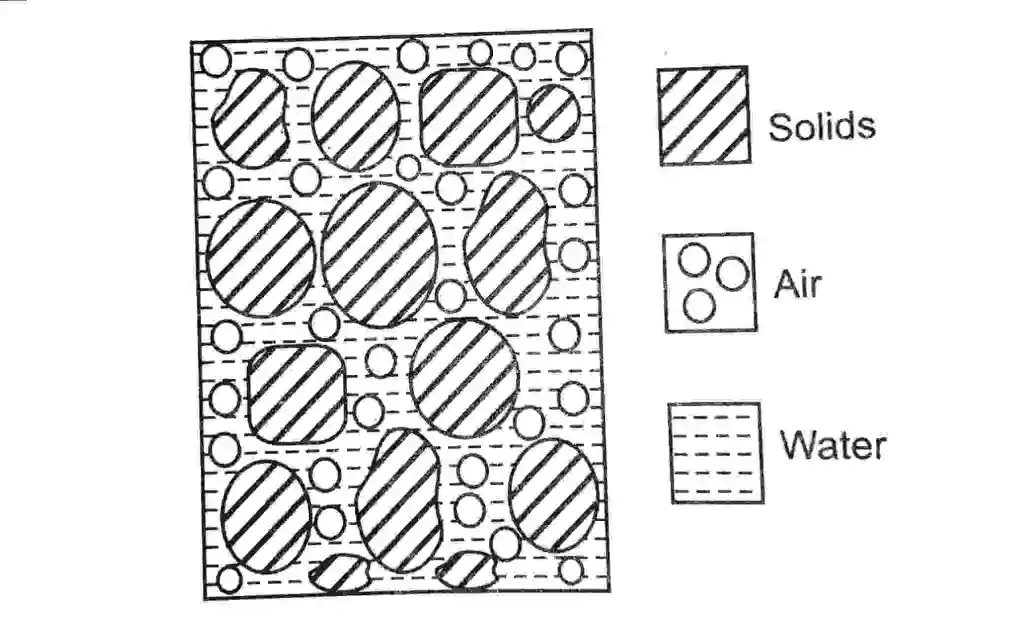
Soil mass is a complex physical system consisting of three distinct phases such as soil grains, liquid (water) and air (gas) at normal condition. In other words a soil mass consists of solid soil particles, containing void space between them. The space between the soil particles is known as void and these voids may be filled either with air or water or both.
The soil will behave as a two phase system when its void space is filled with either water or air alone. When all void space is filled with either water, the soil mass is fully saturated and exist in two phases as solid and water. When all the void space is filled with air the soil mass becomes dry soil and exists
in two phases as solid and air. But as when the soil mass is partially filled up by water as well as air and hence it behaves three phase system.
The diagrammatic representation of the different phases in a soil mass is called the phase diagram. The three constituents of a soil mass do not occupy separate but are blended together forming a complex material as shown in figure.
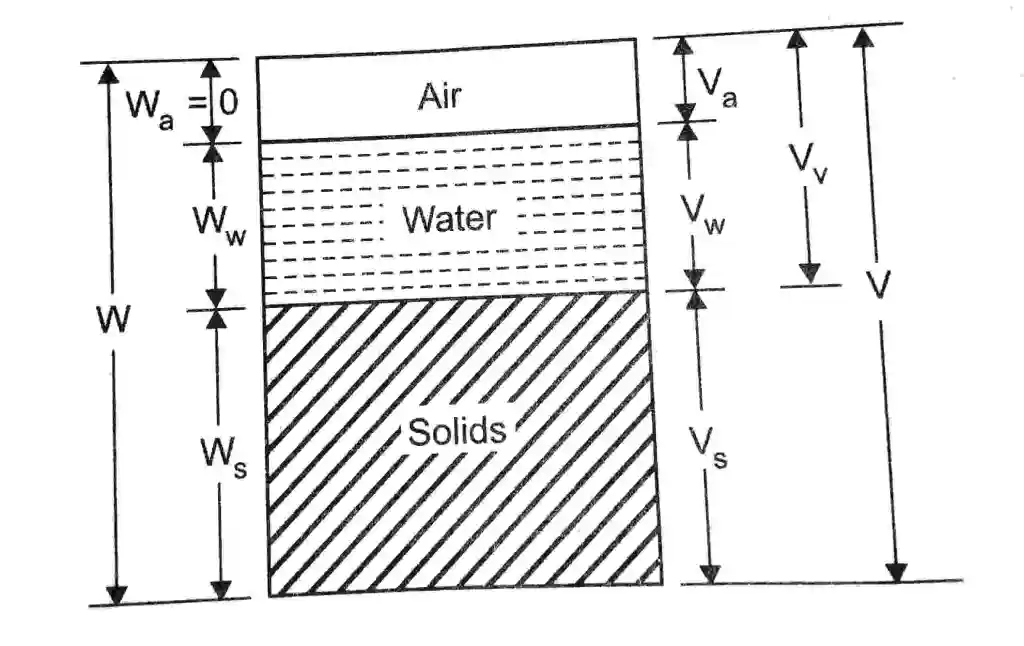
The total volume V of the soil mass is equal to the sum of volume of solid particle
`V_s` volume of water `V_w` and volume of air `V_a`. i.e. - `V =V_s+V_w+V_a`.
Also, Volume of voids (`V_v`) equal to the sum of volume of air and volume water,
i.e., `V_v = V_a + V_w`
and, ` V = V_v + V_s`
Similarly,
Total weight (W) = Weight of soil grains (`W_s`) + Weight of water (`W_w`) + Weight of air (`W_a`)
i.e., `W = W_s+ W_w + W_a`
Also,
Weight of void` (W_v) = W_a + W_w`
However, the weight of air being negligible i.e., `W_a~= 0` hence,
`W_v = W_w`
Thus, total weight of soil mass is;
`W = W_{w} + W_{s}`
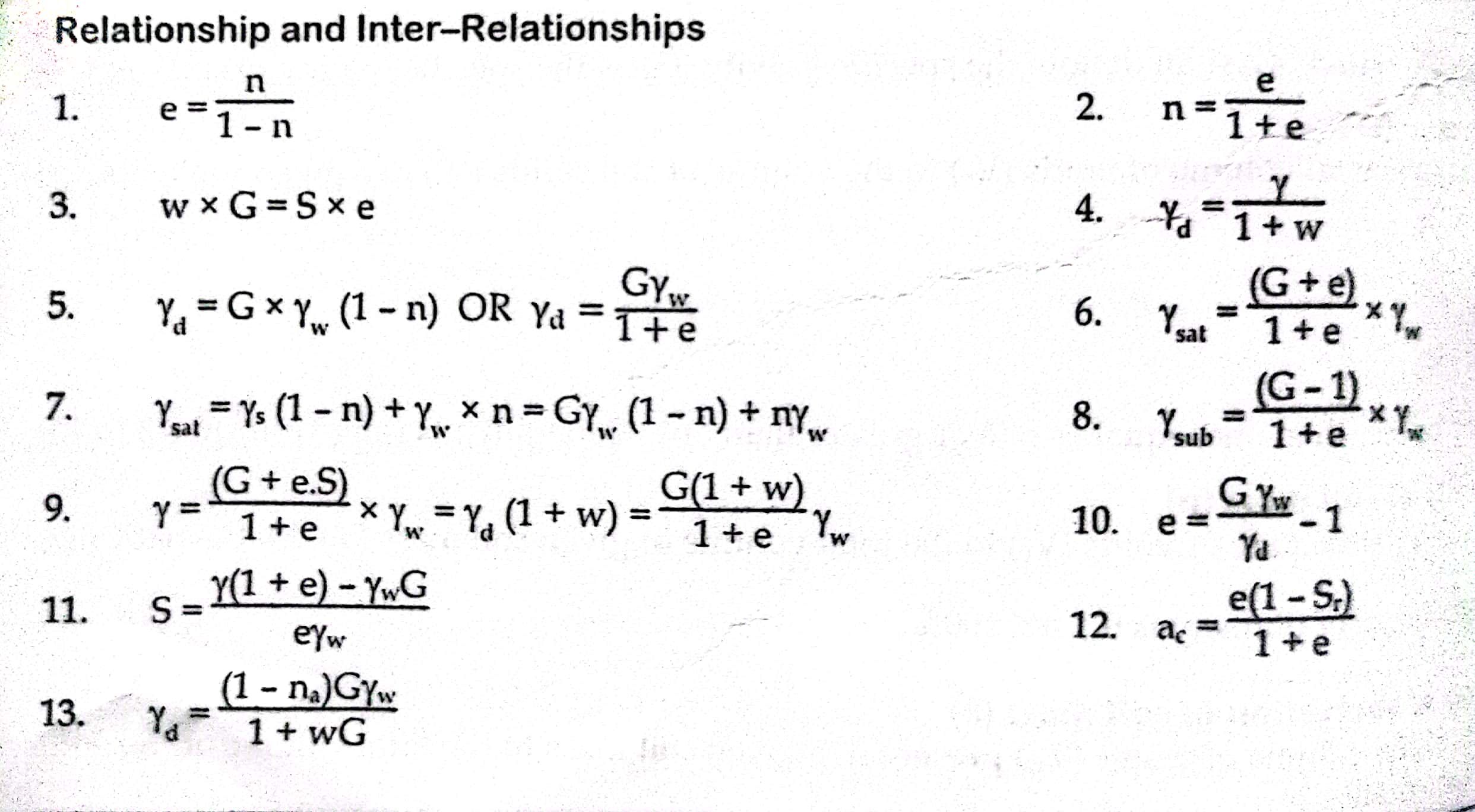
3. Relationship and Inter-Relationships
4. Briefly explain various terminologies.
Void ratio:
Void ratio is defined as the ratio of volume of voids to the volume of solid particles i.e,
`e=V_v/V_s`
`or, e=(V_w+V_a)/V_s`
Its value may be less than one, equal to one or greater than one. Generally, its range is form 0.5 to 1.5
Porosity:
Porosity denoted by n, is defined as the ratio of volume of voids to the total volume of soil. It is expressed in percentage.i.e,
`n=V_v/V*100`
`=(V_a+V_w)/(V_a+V_w+V_s)*100`
Degree of saturation:
Degree of saturation denoted by $S_r$ is defined as the ratio of volume of water to the total volume of voids in the soil mass. It is expressed in percentage.i.e,
`S_r=V_w/V_v*100`
For a fully saturated soil mass;
`V_v=V_w`, hence `S=1`.
The submerged soil is fully saturated soils.
For perfectly dry soil mass;
`V_w=0` and hence `S = 0`.
Water content:
Water content or content of a soil mass, denoted by w, is defined as the ratio of weight of water to the weight of dry soil. i.e,
`w=W_w/W_s`
The weight used in the about expressions is the weight of water loss when the soil is heated to a temperature of 105 degree centigrade to 110 degree centigrade for such length of time that its weight is constant. In routing laboratory test, a period of 24 hours is considered enough for drying.
Bulk unit weight:
Bulk Unit Weight or mass unit weights denoted by `gamma_t` is defined as the weight of soil mass per unit volume of soil mass.i.e,
`gamma_t=W/V`
=`(W_s+W_w)/(V_s+V_w+V_a)`
Dry unit weight:
Dry Unit Weight denoted by `gamma_s` is defined as the ratio of weight of solid to volume of soil.i.e,
`gamma_s=W_s/V`
Unit weight of water:
It is the ratio of weight of water per unit volume of water.i.e,
`gamma_w=W_w/V_w`
Saturated Density:
When the soil mass is saturated, its bulk density is called the saturated density. Thus saturated density is the ratio of the total weight of a saturated soil sample to its total volume (V).
i.e, `gamma_(s a t)=W_(s a t)/ V`
Submerged Density:
The submerged density or buoyant unit weight is defined as the submerged weight of the soil solids per unit of total volume (V) of the soil mass.
`gamma_(s u b)=((W_s)_(s u b) )/V`
`gamma_(s u b)=gamma_(s a t)-gamma_w`
Density (unit weight) of solids:
The unit weight of soil solids is the weight of soil solids per unit volume of solids (Vs);
i.e, `gamma_s=W_s/V_s`
Specific gravity of solids:
It is the ratio of Unit Weight of soil solid to Unit Weight of water at 4 degree centigrade.i.e,
`G=gamma_s/gamma_w`
`=W_s/(V_s*gamma_w)`
NOTE:
Unless otherwise stated, we shall denote the specific gravity (G) as the specific gravity of soil solids
Specific gravity of water:
It is defined as the ratio of Unit Weight of water at any temperature to Unit Weight of water at 4 degree centigrade.i.e,
`G_t=gamma_w/gamma_0`
Where,`gamma_0` is the Unit Weight of water at 4 degree centigrade.
Percentage of air voids:
It is the ratio of the volume of air volds to the total volume of the soil mass (V) and is expressed as percentage. Mathematically,
`eta_a=V_a/V**100`
Air Content:
It is the ratio of the volume of air voids to the volume of voids.
i.e, `a_c=V_1/V_v`
since `V_a=V_v-V_w`, `a_c=1-V_w/V_v=1-S`
Where S is the degree of saturation.
Density index or relative density or degree of density of soil mass :
It is the ratio of the difference between the volds ratio of the soil in its loosest state (`e_(m a x)`) and natural voids ratio (`e`) to the difference between the voids ratio in the loosest state (`e_(m a x)`) and t densest state (`e_(m i n)`). Mathematically
`I_D=(e_(m a x)-e)/(e_(m a x)-e_(m i n))=(rho_( m a x)(rho-rho_( m a x)))/(rho (rho_( m a x)-rho_( m i n)))`
The value of `I_D` varies from zero to unity.
If `I_D=0` then natural state of soil is in loosest form.
If `I_D=1` then natural state of soil is in densest form
5. Briefly classify soil.
Soil classification is the arrangement of soils into different groups such that the soils in a particular group have similar behaviour.
Soil can be classified on the following basics:
- Descriptive Classification of soil
- Texural classification
- ISI classification
- MIT classification system
- AASHTO classification system
- Unified soil classification system (USCS)
Descriptive Classification of Soil
1) Boulder, gravel & sand :
These are coarse grained soils and soil particles that belong to this category posses no cohesion among themselves. The main distinguishing physical feature among boulders, gravels and sands is the size of their particles. Boulders are larger than gravel particles. Gravels are larger than sand particles.
2) Silt:-
It is a fine grained soil and occurs in two varieties non-plastic varieties including rock flour and plastic varieties containing finely divided particles of organic matter.
3) Clay :-
Soil particles smaller than 0.002mm size and capable of showing plasticity when wet are called clays. The property of plasticity of clay is exhibited over a large
plasticity range of water content.
4) Peat :
It is a partly carbonized organic matter and is fibrous in nature.
5) Loess:
Fine grained yellow colored soil having cohesive nature. It is deposited by wind blow.
6) Hardpan:
Soil strata which remains hard when wet.
7) Bentonite:
It is volcanic ash which contains montmorillorite.
8) Top soil:
Disintegrated surface materials which supports plant & animals etc.
9) Mooram:
Mixture of iron, stone, gravels & red clay.
10) Laterite:
Soil having perforated & cellular structure.
11) Varved clay:
Alternate deposition of silt & clay.
12) Loam:
It is the mixture of sand, clay and silt.
Texural classification of Soil:
The classification of soil exclusively based on particle size and their percentage distribution is known as textural classification system. This system specifically names the soil depending on the percentage of sand, silt and clay.
It is also commonly referred to as the triangular classification of soil.
In this classification, first of all, the soil sample is sieved to determine the percentage of sand, silt, and clay-sized particles. Utilizing the obtained relative percentage, the triangular chart is filled.
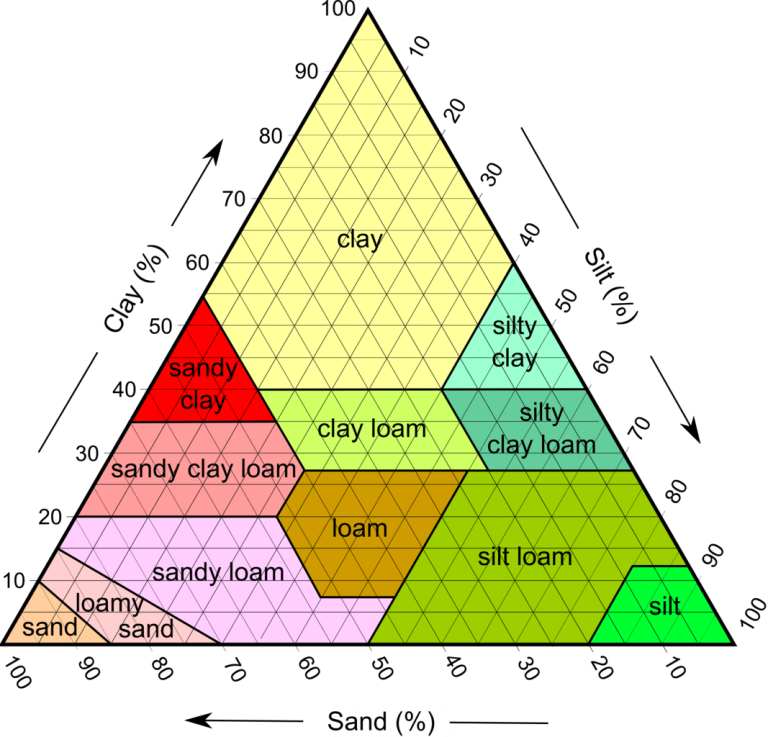
This method of classification doesn’t reveal any properties of the soil other than grain-size distribution. Hence it is suitable for the grain size distribution of coarse-grained soil only.
MIT classification system:

Indian Standard Soil classification system(ISSCS or ISI)
Indian Standard Classification System (ISC) was adopted by Bureau of Indian Standards is in many respect similar to the Unified Soil Classification (USC) system. Soils are divided into three broad divisions:
- Coarse grained soils, when 50% or more of the total material by weight is retained on 75 micro IS sieve.
- For fine grained soils, when more than 50% of the total material passes through 75 micron IS sieve.
- If the soil is highly organic and contains a large percentage of organic matter and particles of decomposed vegetation, it is kept in a separate category marked as peat (Pt).
Unified Soil Classification System (USCS)
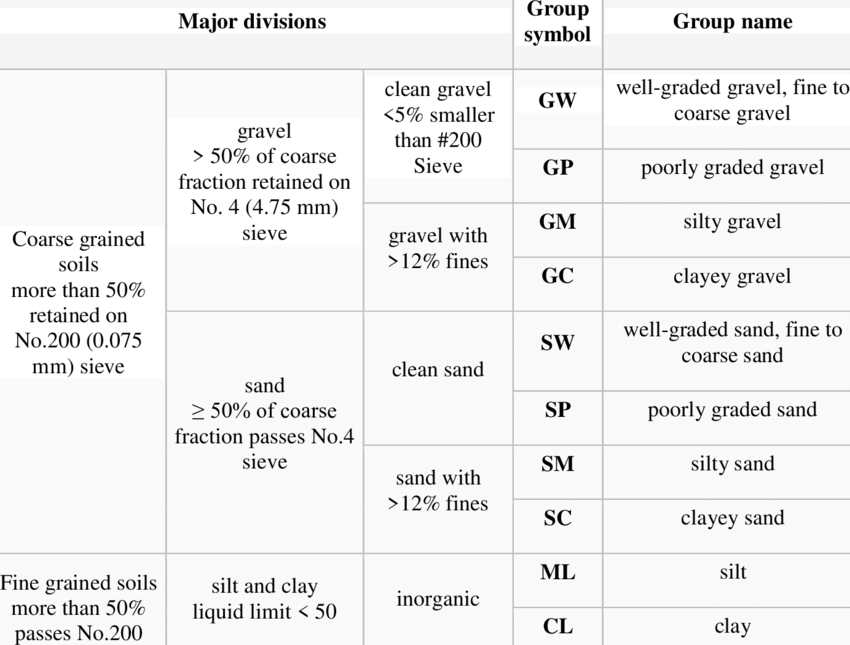
The USCS is a modified version of the soil classification system developed by A. Casagrande. In this system, coarse-grained soil is classified based on grain size distributions whereas, fine-grained soils are classified based on the plasticity of the soil. Soils are categorized into 4 major groups:
Coarse-grained soils:
Fine-grained soils
Organic soils
Peat
Coarse grained soils are those with more than 50% of the material larger than 0.075mm (sieve number 200) size. Coarse grained soils are further classified into gravels (G) and sands (S). The gravels and sands are further divided into four categories according to gradation, silt or clay content. Fine grained soils are those for which more than 50% of soil finer than 0.075 mm sieve size. They are divided into three sub-divisions as silt (M), clay (c), and organic salts and clays (O). based on their plasticity nature they are added with L, M and H symbol to indicate low plastic, medium plastic and high plastic respectively.
AASHTO Soil Classification System:
American Association of State Highway and Transportation Officials (AASHTO) classification system is useful for classifying soils for highways. This classification is based on both particle size ranges and plasticity characteristics. The system comprises seven groups of inorganic soils, A-1 to A-7 with 2 sub - groups in all. The system is based on the following three soil properties:
- particle size distribution,
- liquid limit and
- plasticity index.
A group index is introduced to further differentiate soils, containing appreciable fine grained materials. (Group index is not used to place a soil in a particular group; it is actually a means of rating the value of a soil as a sub-grade material within its own group. The higher the value of group index, the poorer is the quality of the material.)
Group index is given by the following equation: Group index (G.L)= 0.2a + 0.005ac + 0.01bd
where, a is that portion of percentage passing 75 micron size sieve, greater than 35 and not exceeding 75 expressed as whole number (0 to 40) = (F -35)
b is that portion of percentage passing 75µ size sieve, greater than 15 and not exceeding 35 expressed as whole number (0 to 40) = (F - 15)
c is that portion of the liquid limit greater than 40
d is that portion of the plasticity index greater than 10
F is the percent passing No. 200 sieve (0.0075 mm)
