MCQ
Which of the following relations is symmetric and transitive but not reflexive for the set I = {4, 5}?
 Login to ask a question from Relations and Functions II
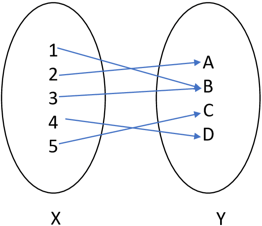
From Relations and Functions II · Objective Mathematics
Which of the following relations is symmetric and transitive but not reflexive for the set I = {4, 5}?
(a,a) ∈ R, for every a ∈ A. This condition is for which of the following relations?
Let P={10,20,30} and Q={5,10,15,20}. Which one of the following functions is one – one and not onto?
If f:N→N, g:N→N and h:N→R is defined f(x)=3x-5, g(y)=6y2 and h(z)=tanz, find ho(gof).
An Equivalence relation is always symmetric.
Which of the following relations is transitive but not reflexive for the set S={3, 4, 6}?
(a1, a2) ∈R implies that (a2, a1) ∈ R, for all a1, a2∈A. This condition is for which of the following rel…
If f:R→R, g(x)=3x2+7 and f(x)=√x, then gοf(x) is equal to ___
