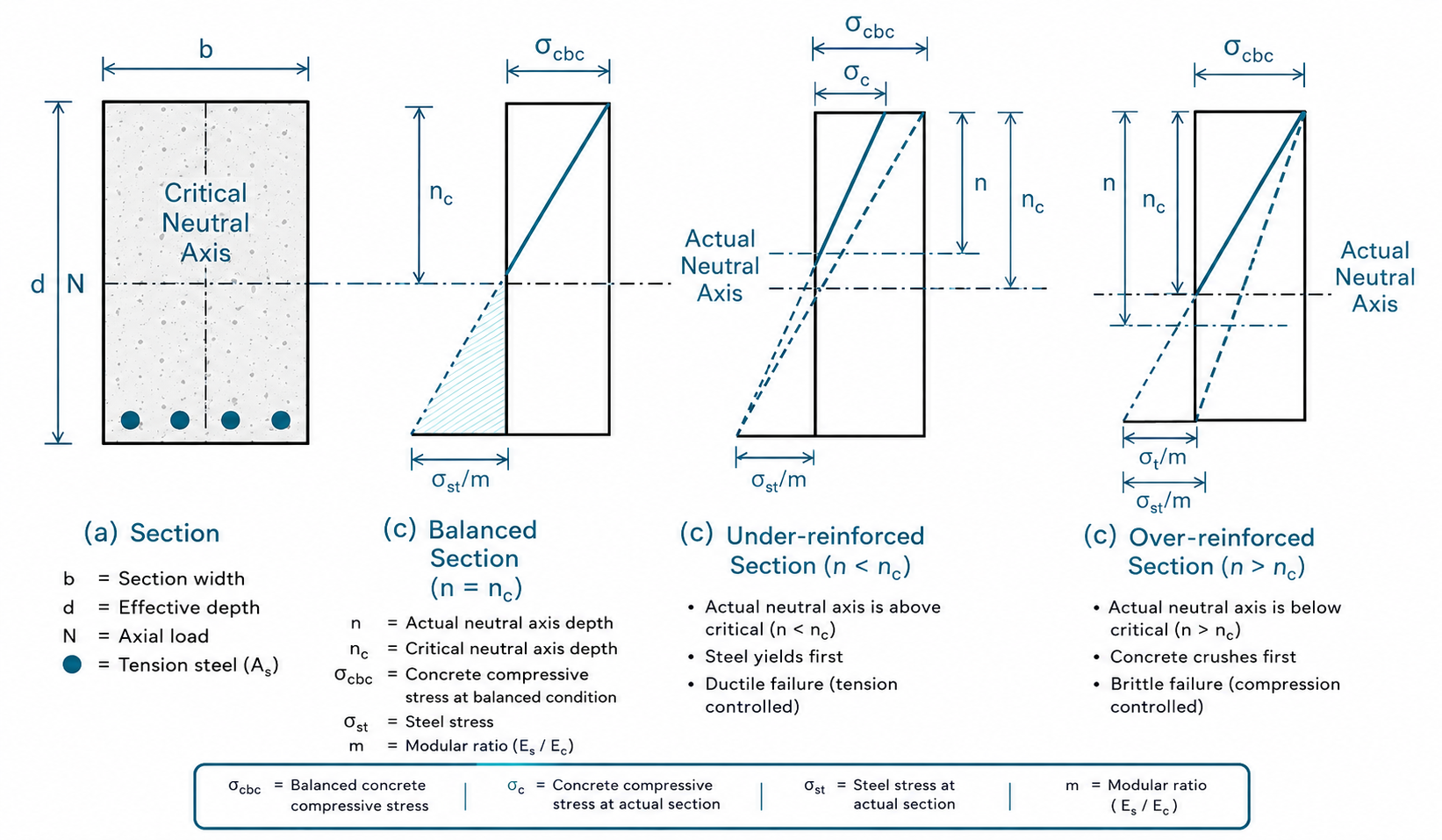
Depending on the behavior, RCC sections are classified as: Under-reinforced section, Over-reinforced section, and Balanced section.
a) Under-reinforced Section (URS):
URS can be defined as the section that is so proportioned that the stress in steel reaches its permissible value earlier than concrete.
The percentage of steel provided is less than that provided in balanced section.
So the actual neutral axis will shift upwards (n < nc).
In URS, the failure is ductile because steel fails first and sufficient warning is given before collapse.
The percentage of steel is less than the balanced section, hence the section is economical.
The moment of resistance is less than balanced section.
Due to ductile failure and economy, the under reinforced sections are preferred by the designers.
b) Over-reinforced Section (ORS):
ORS can be defined as the section that is so proportioned that the stresses in concrete reach its permissible value earlier than steel. The stress in steel will thus be lesser than its permissible value.
In an over-reinforced section, the percentage of steel provided is greater than the balanced section.
So, the actual neutral axis shifts downward i.e., (n > nc).
In this section, concrete is brittle and it fails by crushing suddenly.
As there are no warning of failure in such section and are not economical, over reinforced sections are not preferred by designers.
Neutral axis shifts lower than the critical neutral axis since steel is not subjected to full value of permissible tensile strength.
It is known as primary compression failure or compression failure.
c) Balanced Section (BS):
BS can be defined as the section that is so proportioned that the stress in concrete and steel reaches their permissible value at the same time.
It is also known as critical or economical section.
The percentage of steel corresponding to balanced section is known as balanced steel and the neutral axis is called as critical neutral axis.
 Login to ask a question from Reinforced Concrete Structures