Horizontal angle measurement using theodolote lab report
Course: IOE SURVEYING II LABSHEET — Practice MCQs, solutions, formulas & past entrance questions.
 Guest
Guest
Chapter:
| 1. DETERMINATION Of THE HORIZONTAL ANGLE USING THEODOLITE |
TITLE:
DETERMINATION Of THE HORIZONTAL ANGLE USING THEODOLITE
OBJECTIVES:
To become familiar working with angles in degrees, minutes and seconds format.
To use theodolite to measure the horizontal angle.
THEORY:
The theodolite is the most precious instrument design for the measurement of horizontal and vertical angles and has wide applicability in surveying such as laying off horizontal angles, locating points on line, prolonging survey line, establishing grades, determining difference in elevation, setting out curve etc. Generally, the temporary adjustment of theodolite includes:
setting up over the station
levelling up
Elimination of the parallax
Theodolite are generally of two types:
Transit theodolite and
Non-transit theodolite
In the transit theodolite, the telescope can be revolved through a complete revolution about its horizontal axis in a vertical plane.
In the non transit theodolite, the telescope cannot be revolved through a complete revolution in a vertical plane.
Instrument used:
Theodolite
Tripod
Ranging rod
Plumb Bob
Arrow.
Procedures:
Suppose it is required to measure angle AOB.
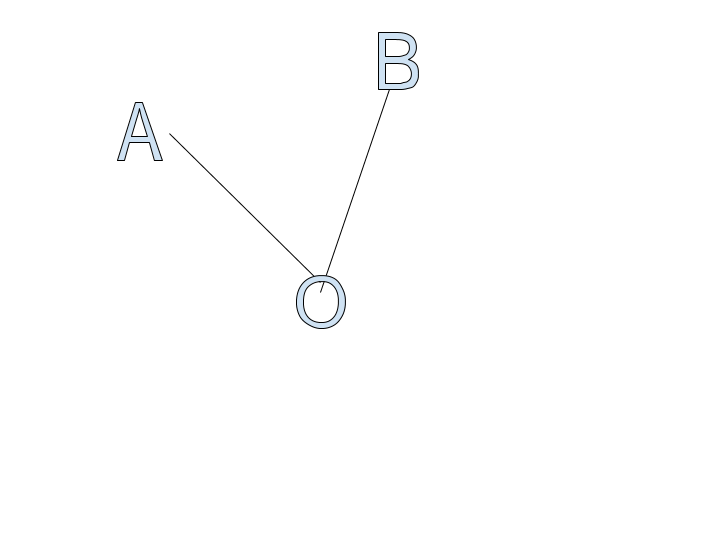
The theodolite is set up at point O and centred and labelled accurately.
A 0 degree HCR reading was set initially.
The lower clamp is then loosened and the telescope is directed towards station A. Now, after clamping the lower clamp, the ranging rod at station A was bisected accurately by lower tangent screw.
The upper clamp was then unclamped and the instrument was rotated clockwise toward station B. The upper clamp was then clamped and the ranging rod at station B was bisected with the help of upper tangent screw.
The HCR at that instant was noted.
Now, the face was changed and the above process was repeated.
The above process was repeated for two sets reading and the mean angle was calculated.
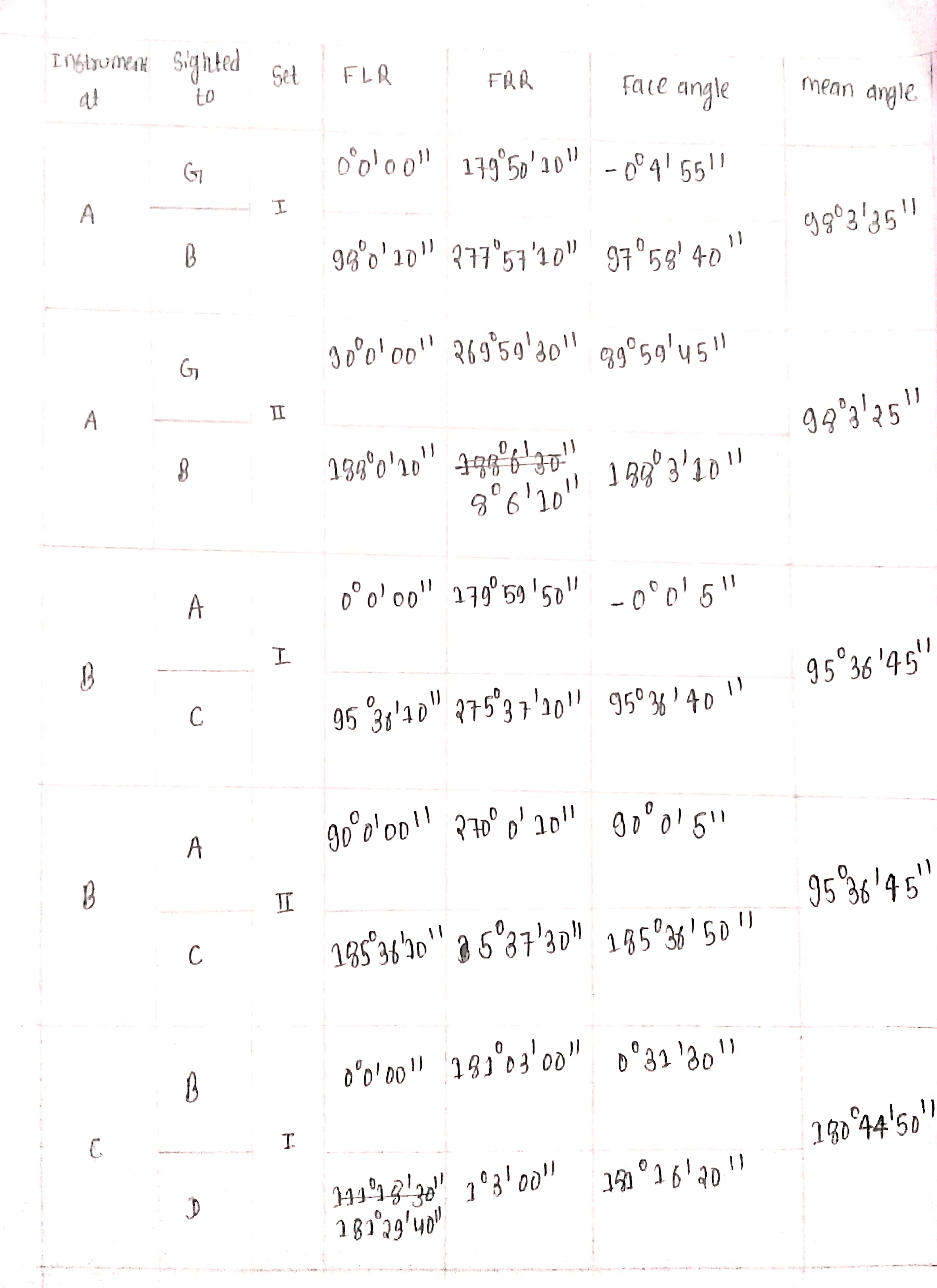
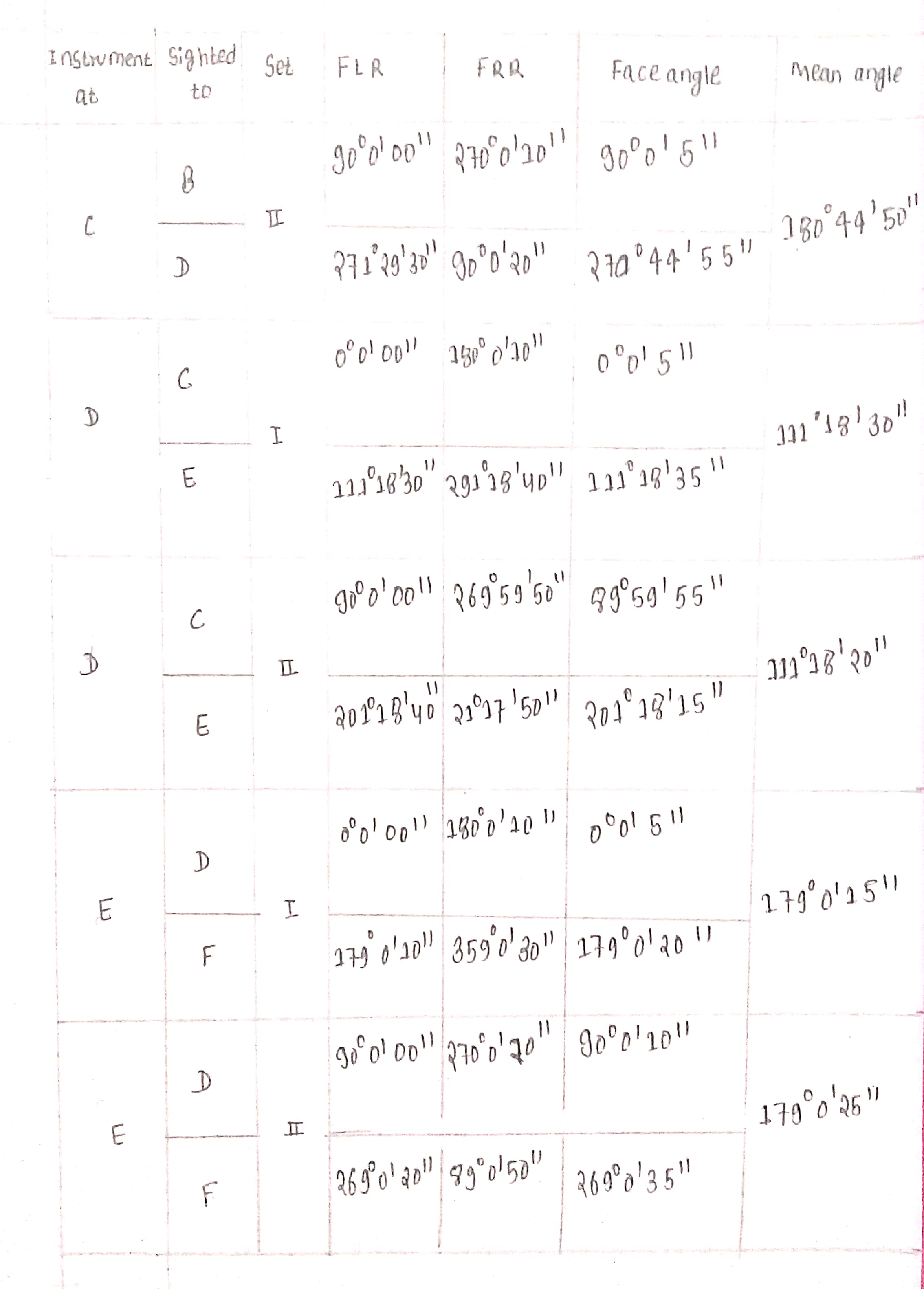
Observation table :

Calculations:
Mean horizontal angle Computation:
`angle GAB=angle A=98^0 3^'30^('')`
`angle ABC=angle B=95^0 36^'45^('')`
`angle BCD=angle C=180^0 44^'50^('')`
`angle CDE=angle D=111^0 18^'25 ^('')`
`angle DEF=angle E=179^0 0^'20^('')`
`angle EFG=angle F=58^0 05^'45 ^('')`
`angle FGA=angle G=177^0 10^'35^('')`
Here, the observed sum of interior angle is
`= 900^0 0^'10^('')`
Total number of angles `=7`
Theoretical sum of interior angles is given by:
`=(2N-4)*90^0`
`=900^0 0^'00^('')`
Thus, error is given as:
Error= observed value - Theoretical value
`= 900^0 0^'10^('')- 900^0 0^'00^('')`
`= 0^0 0^'10^('')`
Now, maximum permissible error is
`= 0^0 0^'30^('')`
Here,The error observed during the field observation is `0^0 0^'10^('')` which lies within the maximum permissible error.
Hence, no any correction is required in the calculation of the interior angle. Hence, the calculated horizontal angles can be assumed to be accurate with sufficient precision.
Results:
Hence, the horizontal angle of a closed traverse was computed using transit analogue theodolite.
Sources of error:
Instrumental errors
Natural errors
Personal errors
Instrumental Errors:
Imperfect graduation.
line of collimation not being perpendicular to trunnion Axis.
Horizontal axis not being perpendicular to the vertical axis.
on-Parallelism of the axis of telescope level and line of collimation.
Natural Errors:
Unequal atmospheric refraction due to high temperature.
Unequal expansion of the various part of the instrument.
unequal settlement of the tripod.
poor visibility.
strong wind producing vibration to the instrument
Personal Errors:
Inaccurate Levelling,
inaccurate centring,
improper use of tangent screw
Slip
inaccurate bisection of signals
Non-verticality of ranging rod
Precautions:
The instrumental errors, if any, should be minimised or eliminated by applying appropriate correction and adjustment.
Apparatus should be handled carefully.
one should be careful while taking/reading data.
the Arithmetic calculation should be checked.
one should be careful with the use of tangent screw.
the ranging rod should be bisected at minimum possible height.
Conclusion:
In conclusion we had great experience in hands on during our fieldwork in theodolite, where we become able to determine the horizontal angle between adjacent stations.
