 Guest
Guest
Chapter:
1. Explain various methods for measurement of dynamic viscosity of a fluid.
Determination of Dynamic Viscosity:
Falling ball method
Rotating cylinder viscometer
Falling ball method:
This method is used to measure viscosity by balancing the force..
If a body is dropped, starting from rest, in the atmosphere, it will accelerate due to gravity. As the speed of body increases, the body will experience a drag force, which tends to oppose the motion of the body. The drag force increases with a velocity of the fall and after certain time when velocity approaches terminal velocity, the upward drag would just balances the downward weight force such that the net force acting on the body will be zero.
Figure below shows the small rigid sphere of radius r and density `rho_s` falling freely from rest under the action of gravity through a liquid of density `rho_l` and viscosity `mu`. After certain time, it attains the equilibrium state.

Now, at equilibrium state,
Stokes had experimentally found that,
Drag force=`6pi mu r V_t`
Weight= upthrust+ drag force
`4/3pi*r^3*rho_s*g=4/3pi*r^3*rho_l*g+6pi mu r V_t`
Solving for `mu`, we get,
`mu=2/9*(r^2)/(V_t)*(rho_s-rho_l)g`
This equation can be used to calculate the dynamic viscosity of a sphere. This is valid for laminar flow with Reynolds number less that 0.1.
Rotating cylinder viscometer:
Rotating cylinder is used to measure viscosity by balancing the torque.
Rotational viscometers use the idea that the torque required to turn an object in a fluid is a function of the viscosity of that fluid. They measure the torque required to rotate a disk or bob in a fluid at a known speed.
Figure below shows the experimental setup. Let the outer cylinder is rotating with constant angular velocity `omega` whereas the inner cylinder is stationary and equipped with torque measuring devices. Let `r_1` and `r_2`be the radius of outer and inner cylinder respectively. Let t be the thickness of fluid separating two cylinders.

Now, thickness of oil film is,`t=(r_1-r_2)`
The shear stress is,
`tau=mu*(du)/(dy)=mu*(2 pi*N*r_1)/(60t)`
Where, N is the revolution per minute of outer cylinder.
Now, viscous force is, `F=tau*A=mu*(2 pi*N*r_1)/(60t)*2pi*r_2*L`
Where, L is the length of cylinder.
Thus, the viscous torque is given by,
`T=F*r_2=mu*(2 pi*N*r_1)/(60t)*2pi*r_2*L*r_2`
or,`T=1/15*mu*(pi)^2*r_1*(r_2)^2*L*N`
or,`mu=(15t)/((pi)^2*r_1*(r_2)^2*L*N)`
This equation can be used to calculate the dynamic viscosity.
2. The space between two square flat parallel plate is filled with oil. Each side of plate os 720 mm. The thickness of oil film is 15 mm. The upper plate which moves at 3 m/s requires a force of 120 N to maintain speed. Determine:
- dynamic viscosity of oil
- kinematic viscosity of oil if specific gravity of oil is 0.95
SOLUTION:
Given,
Each side of the square plate =720 mm = 0.72 m
Thickness of the oil film, `dy=15 mm=0.015 m`
Velocity of the upper plate, `du=3`m/s.
Force required on the upper plate; `F=120 N`
Dynamic viscosity, `mu=?`
Kinematic viscosity, `nu=?`

Now,we have,
`tau=mu*(du)/(dy)`
or, `mu=tau*(dy)/(du)`
`=F/A*(dy)/(du)`
`=120/(0.72\ *\ 0.72)*0.015/3`
Thus, `mu=1.16`Ns/`m^2` `=11.6`poise.
Also, we have,
Kinematic viscosity, `nu=mu/rho`
Also, specific gravity`=0.95=rho/1000`
Thus, `rho=950`kg/`m^3`
Thus,
`nu=1.16/950`$*$1.22$ *$`10^(-3) m^2/s`
`nu=12.21` stokes.
3. If surface tension at air-water interface is 0.069 N/m, What is pressure difference between inside and outside of an air bubble of diameter 0.009 mm?
SOLUTION:
Given,
Surface Tension,`sigma=0.069`N/m
Diameter of air bubble,`d=0.009`mm
Since an air bubble has only one surface,
`P*(pi*d^2)/4=sigma*pi*d`
or,`P=(4*sigma)/d=30667`N/`m^2`
4. A plate having an area of `0.6 m^2` is sliding down inclined plane at an angle of `30^0` to horizontal with a velocity of 0.36 m/sec. There is a cushion of fluid 1.8 mm thick between plane and plate. Find viscosity of fluid if weight of plate is 280N.
SOLUTION:
Given,
Area of plate,`A=0.6 m^2`
Velocity of the plate,`u=0.36`m/s
Thickness of the film,`dy=1.8`mm
Weight of the plate,` W=280 N`
Viscosity of the fluid,` mu=?`

Now,
Shear force on the bottom surface of the plate is given by,
F= component of weight along the plane.
or, `F=W*sin30 =140 N`
Thus, shear stress `tau=F/A=140/0.6 =233.33` N/`m^2`
We have,
`tau=mu*(du)/(dy)`
or, `mu=233.33/0.36 *1.8/1000=1.1667`Ns/`m^2`
or, `mu=11.667` poise.
5. Explain continuum concept of Fluid.
A continuous and homogeneous medium is called continuum. From the continuum view point, the overall properties and behaviour of fluids can be studied without regard for its atomic and molecular structure. A fluid behaves as if it were comprised of continuous matter that is infinitely divisible into smaller and smaller parts. This idea is called continuum assumption.
Thus, the fluid properties such as density, temperature, velocity and so on can be considered to be constant at any point and changes due to molecular motion may be ignored.
This assumption break down in case of rarefied gases, for which the mean free path of the molecules to the physical dimensions of the problem is larger.
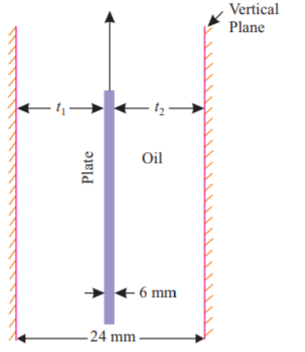
6. A metal plate 1.25m ** 1.25 m ** 6 mm thick and weighing 90 N is placed midway in 24 mm gap between two vertical plane surface as shown below. The gap is filled with an oil of specific gravity 0.85 and dynamic viscosity 3 Ns/`m^2`. Determine force required to lift plate with a constant velocity of 0.15 m/s.
SOLUTION:
Given,
Area of the plate, `A=1.25**1.25=1.5625 m^2`
Specific gravity of the oil, `S=0.85`
Thickness of the plate = 6 mm
Now,
`t_1=t_2=(24-6)/2=9 mm`
Thus,
Shear Force required to drag the plate vertically =shear force due to fluid between the plate and left vertical plane + shear force due to fluid between the plate and right vertical plane
or, `F=F_1+F_2`
or, `F=tau_1*A+tau_2*A`
or, `F=A*(tau_1+tau_2)`
or, `F=A*mu*V*(1/t_1+1/t_2)`
or, `F=156.25 N`
Again,
Upward thrust or buoyant force on the plate is,
`=V*rho*g`
`=(1.25**1.25**0.006)**0.85**1000**9.81`
`=78.17 N`
Now, the effective weight of the plate `=90-78.17 =11.83 N`
Thus, the total force required to lift the plate at velocity of 0.15 m/s is,
=F+ effective weight of the plate
`=156.25 + 11.83`
`=168.08 N`
7. A square plate of size 1 m x 1m and weighing 350 N slides down an inclined plane with a uniform velocity of 1.5 m/s. The inclined plane is laid on a slope of 5 vertical to 12 horizontal and has an oil film of 1 mm thickness. Calculate dynamic viscosity of oil in poise.
Solution:
Here,
`v=1.5` m/s
`mu=?`
`A=1**1=1m^2`
`W=350\ N`
Now,
Here, `tan theta=5/12`
Thus,
`F= W sin theta=350 sin (22.62)=134.615\ N`
Now, the shear stress is, `tau=mu du/dy`
where, `tau=F/A=134.615`
Thus, `134.615=mu** 1.5/0.001`
or, `mu=0.08974` Ns/m
8. The pressure outside droplet of water of diameter 0.04 mm is 10.32 N/`(cm)^2`. Calculate pressure within droplet if surface tension of water is 0.0725 N/m.
SOLUTION:
Given,
Surface Tension,`sigma=0.0725`N/m
Diameter of air bubble,`d=0.04`mm
Since an air bubble has only one surface,
`P*(pi*d^2)/4=sigma*pi*d`
or,`P=(4*sigma)/d=7250`N/`m^2`
or, `P=0.725`N/`(cm)^2`
Thus, the pressure inside the droplet = P + pressure outside the droplet (atmospheric)
or, `P_(i n)=0.725+10.32`
or, `P_(i n)=11.045` N/`(cm)^2`
9. The velocity distribution of a flow over a plate is parabolic with vertex 30 cm from plate, where velocity is 180 cm/s. If viscosity of fluid is 0.9 N.s/`m^2`, find velocity gradients and shear stress at distances of 0,15 and 30 cm from plate.
SOLUTION:
Given,
Distance of the vertex from the plate =30 cm= 0.3 m
Velocity at the vertex= 180 cm/s =1.8 m/s
Viscosity of the fluid=0.9 Ns/`m^2`

We know, the equation of the velocity profile, which is parabolic, is given by,
`u=ay^2+by+c`... (i)
Where, a,b,and c are constants
The values of these constants are found from the following boundary conditions.
At y=0, u=0
At y=30 cm, u= 180 cm/s
At y=30 cm, `(du)/(dy)=0`
From (i),
`0=0+0+c`
or, c=0
Similarly, at y=30, u=180, so
`u=ay^2+by+c`
or, `180=a*30^2+30b`
or, `180=900a+30b`... (ii)
Similarly,
`(du)/(dy)=2a y+b`
or, `2a*30+b=0`
or, `60a+b=0`... (iii)
From (ii) and (iii), we have,
`a=-0.2`
`b=12`
`c=0`
Thus, at y=0,
Velocity gradient,`(du)/(dy)=-0.4y+12=12`per sec
Shear stress, `tau=0.9*12=10.8`N/`m^2`
Also, at y=15 cm,
Velocity gradient,`(du)/(dy)=-0.4y+12=6`per sec
Shear stress, `tau=0.9*6=5.4`N/`m^2`
And, at y=30 cm,
Velocity gradient,`(du)/(dy)=-0.4y+12=0`per sec
Shear stress, `tau=0.9*0=0`N/`m^2`
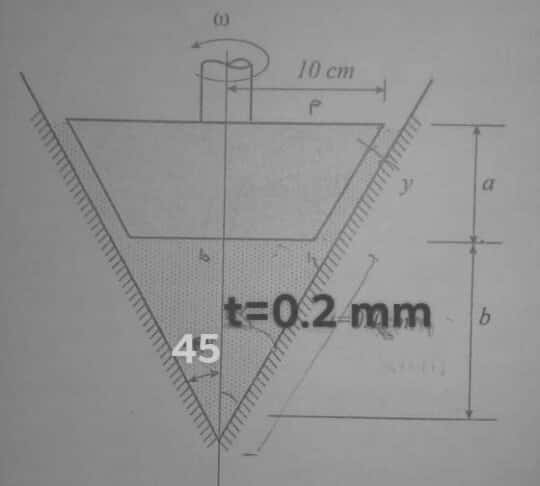
10. Oil of viscosity `mu=0.20`Ns/`m^2` fills small gap of thickness y=0.2 mm as shown in figure. Neglecting fluid stress exerted on circular underside, find torque required to rotate truncated cone at speed of 90 rpm. What is rate of heat generation, in joules per second, if value of `alpha=45^0` a=45 mm and b=60 mm.
SOLUTION:
Given,
Vertex angle = `2 alpha`
Viscosity of the oil,`mu=0.2`Ns/`m^2`
Speed of rotation, `N= 90` rpm
a=45 mm
b=60 mm
Thickness of the oil layer, `t=0.2 mm=0.0002 m`
Let us consider an elementary area `dA` at a height h from the apex of a cone and let the radius at that height be r as shown in figure. Let ds be the inclined length of element and dy be the thickness of element.Now,the elementary area is
`dA=2pir*ds`
or, `dA=2pi*r*(dy)/(cos alpha)`
Now,
Shear stress, `tau=mu*(du)/(dy)`
Let us assume the gap `t` to be small such that the velocity distribution can be assumed to be linear.
Now, for linear velocity profile,
`(du)/(dy)=(omega*r)/h`
Thus,
`tau=mu*U/t`
or, `F=mu*U/t*2pir*(dh)/(cos alpha)`
Thus the torque on the element is given by,
`dT=(mu*U/t*2pir*(dh)/(cos alpha))*r`
`=(mu*(omega*r)/t*2pir*(dh)/(cos alpha))*r`
`=(2pi mu omega r^3)/(t cos alpha)*dh`
From figure,
`r=h tan alpha`
Thus,we get,
`dT=(2pi mu omega)/(t cos alpha)*h^3*tan^3(alpha) dh`
Now, the total torque on the given solid cone can be obtained by integrating this equation from limit `b` to `a+b` .i.e,
Total torque T is,
`T=\int_{b}^{a+b} (2pi mu omega)/(t cos alpha)*tan^3(alpha) *h^3 dh`
`T=(2pi mu omega)/(t cos alpha)*tan^3(alpha) *((a+b)^4-b^4)/4`
Using the values of a and b, we get,
`T=(2pi**0.20**9.424)/(4**0.0002**cos 45)*(0.105^4-0.06^4)`
or, `T=2.2733 Nm`
Also,Rate of heat generation is given by,
`P=T*omega=2.2733**9.424`
or, `P=21.424` J/s
All Chapters
Dimensional Analysis, Similitude and Physical Modelling
Flow Past Through Submerged Body
Boundary Layer Theory
Properties of fluid
- properties of fluids
- complete IOE solution on fluid mechanics
- Detailed description chapterwise
- Unlimited Numericals problem solved with updation daily
- And much more
Hydrostatics
- Hydrostatics basic theory
- All important Numericals
- IOE,PU, MIT,A.M.I.E,Delhi university,EUPS,Engineering service exam solved problems
- Detailed explanation
Hydrostatics- Buoyancy and metacentric height
- detailed explanation of force of buoyancy, metacentric height,stability of floating body
- unlimited numericals solved with updation weekly
- including IOE , PU, KU, GATE, MIT, ANNA UNIVERSITY,UPSC EXAM SOLUTIONS
- And much more
