Reinforced Concrete Structures
Course: Structural Engineering Second Paper — Practice MCQs, solutions, formulas & past entrance questions.
 Guest
Guest
Chapter:
| 1. Explain Types of Rcc Section. |
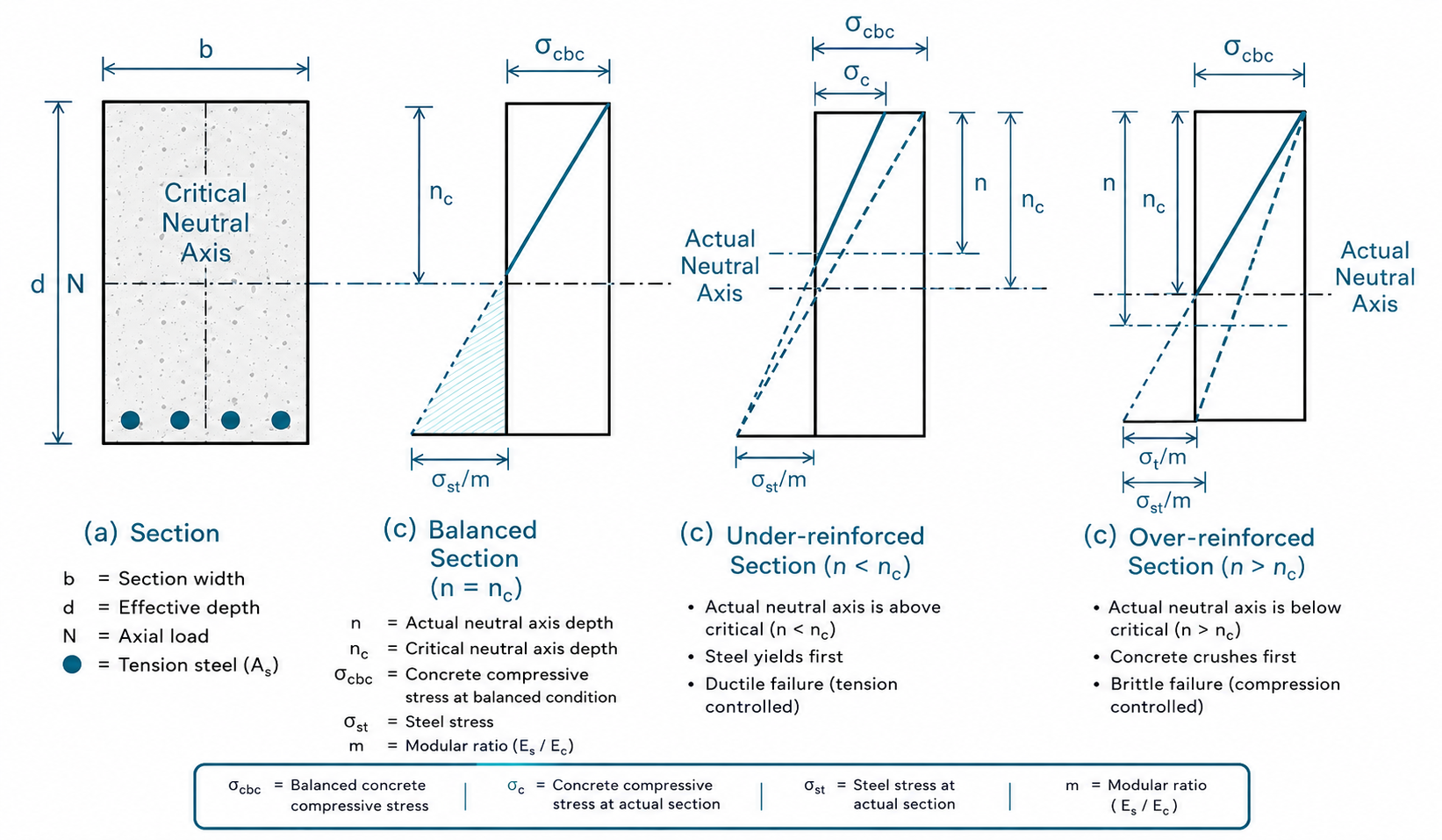
Depending on the behavior, RCC sections are classified as: Under-reinforced section, Over-reinforced section, and Balanced section.
a) Under-reinforced Section (URS):
URS can be defined as the section that is so proportioned that the stress in steel reaches its permissible value earlier than concrete.
- The percentage of steel provided is less than that provided in balanced section.
- So the actual neutral axis will shift upwards (n < nc).
- In URS, the failure is ductile because steel fails first and sufficient warning is given before collapse.
- The percentage of steel is less than the balanced section, hence the section is economical.
- The moment of resistance is less than balanced section.
- Due to ductile failure and economy, the under reinforced sections are preferred by the designers.
b) Over-reinforced Section (ORS):
ORS can be defined as the section that is so proportioned that the stresses in concrete reach its permissible value earlier than steel. The stress in steel will thus be lesser than its permissible value.
- In an over-reinforced section, the percentage of steel provided is greater than the balanced section.
- So, the actual neutral axis shifts downward i.e., (n > nc).
- In this section, concrete is brittle and it fails by crushing suddenly.
- As there are no warning of failure in such section and are not economical, over reinforced sections are not preferred by designers.
- Neutral axis shifts lower than the critical neutral axis since steel is not subjected to full value of permissible tensile strength.
- It is known as primary compression failure or compression failure.
c) Balanced Section (BS):
BS can be defined as the section that is so proportioned that the stress in concrete and steel reaches their permissible value at the same time.
- It is also known as critical or economical section.
- The percentage of steel corresponding to balanced section is known as balanced steel and the neutral axis is called as critical neutral axis.
| 2. Write down difference between Working stress Method and Limit state method of design. |
Working Stress Method (WSM)
WSM is a method of design of a structure on the basis of the behavior of any structure at working load.
Basic assumptions in WSM of design are:
- The material of structure is homogeneous and isotropic.
- The behaviour of structure is linear and elastic.
- There is only one factor of safety (FoS) in material only.
- Load is taken as characteristics load.
- Working stress design methods considers:
- Load → as it is.
- Steel → 1.5 to 1.8 (FoS)
- Concrete → 3 (FoS)
- Timber → 3 to 5 (FoS).
Advantages of WSM:
- This method is simple in calculation and easy to understand.
- This method is reasonably reliable.
- As the working stresses are low, the serviceability requirements are satisfied automatically.
- Structures designed under WSM give better performance during worst combinations of loading and during extreme conditions.
Disadvantages:
- It uses the consideration that the factor of safety times the working load is the failure load which is not true.
- It gives uneconomical section.
- This method implies factor of safety only in material and not in load.
Limit State Design
Limit state design method is the latest approach in structural design which is based on not exceeding the limiting conditions of probable load and probable strength of materials through the probabilistic approach.
Basic assumptions in LSM:
- Plane section before bending remains plane after bending.
- The maximum strain in concrete at its outermost fiber is taken about 0.0035.
- The tensile strength in concrete is totally ignored.
- The compressive strength or stress of concrete is assumed 0.67 times the characteristics strength of concrete cube after 28 days.
- The partial factor of safety is 1.5 for design strength of concrete and 1.15 for steel.
Advantages:
- It uses a multiple safety factor which attempts to provide adequate safety at ultimate load as well as adequate serviceability at working load.
- It involves separate consideration of different kinds of failure, types of material and types of load.
- It gives more economical section.
Disadvantages:
- It is based on probabilistic approach. Hence, the structure may not provide sufficient strength and serviceability at worst combination of loads.
There are two limit states:
i) Ultimate Limit State:
- Failure of structure is due to collapse.
- Ultimate limit state is reached when structure is collapsed.
- It should be safe in flexure, compression, shear and torsion.
ii) Serviceability Limit State:
- Failure of structure is due to excessive settlement or cracking.
- Deflection should not be greater than span/250 and surface crack width is not greater than 0.3 mm.
Difference between WSM and LSM
| S.No | Working Stress Method (WSM) | Limit State Method (LSM) |
|---|---|---|
| 1 | Stress-strain behavior is linear i.e. follows Hooke's law. | Stress-strain behavior is non-linear. |
| 2 | No factor of safety is used for loads. | Design loads are obtained by multiplying partial safety factors of load to the working loads. |
| 3 | This method gives thicker section. So, less economical. | This method is more economical as it gives thinner sections. |
| 4 | This method assumes that the actual loads, permissible stresses and factor of safety are known. So it is called a deterministic method. | This method is based upon the probabilistic approach which depends upon the actual data or experience, hence it is called a non-deterministic method. |
| 5 | It is easy for calculation. | It requires more calculation so, it makes it somewhat difficult to design. |
| 6 | It is based on elastic theory. | It is based on plastic theory. |
| 7 | It does not give an idea about the excess load which a structure can carry beyond the working load without collapse. | It gives an idea about the excess load which a structure can carry beyond the working load without collapse. |
| 8 | In WSM, tensile stress of concrete are considered. | In LSM, tensile stress of concrete are not considered. |
| 9 | Modular ratio m = 280 / (3 σcbc) is generally taken into consideration to calculate allowable stresses. | The ultimate stresses are considered as allowable permissible stresses. |
| 10 | Material strengths are not fully utilized in designing the member of structure. | Material strengths are fully utilized in designing the member of the structure. |
