Laminar Pipe Flow
Course: Hydraulics — Practice MCQs, solutions, formulas & past entrance questions.
 Guest
Guest
Chapter:
|
9. An oil (µ = 20 cP, ρ = 1200 kg/m3) flows through a 2.5 cm I.D. pipe 250 m long.
|
All Chapters
Topics
An oil of viscosity `0.15 (Ns)/m^2` and specific gravity 0.9 is flowing through a circular pipe of diameter 30 mm and of length 3 m at `1/10` th of critical velocity for which Reynolds number is 2450. Find:
- The velocity of flow through pipe,
- The head in metres of oil across pipe length required to maintain flow, and
- The power required to overcome viscous resistance to flow of oil.
A total of 12 litres per second of oil is pumped through two pipes in parallel, one 12 cm in diameter and or 10 cm in diameter, both pipes being 1000 metres long. The specific gravity of oil is 0.97 and kinematic viscosity 9 `(cm)^2` per second. Calculate flow rate through each pipe and power of pump.
A crude oil of viscosity `0.9` poise and relative density `0.9` is flowing through a horizontal circular pipe of diameter `120` mm and length `12` m. Calculate difference of pressure at two ends of pipe, if `785 N` of oil is collected in a tank in` 25` seconds.
A lubricating oil of viscosity 1 poise and specific gravity 0.9 is pumped through
a 30 mm diameter pipe. If pressure drop per metre length of pipe is `20( kN)/m^2`, determine:
- The mass flow rate in kg/min,
- The shear stress at pipe wall,
- The Reynolds number of flow, and
- The power required per 50 m length of pipe to maintain flow.
An oil of viscosity 9 poise and specific gravity 0.9 is flowing through a horizontal pipe of 60 mm diameter. If pressure drop in 100 m length of pipe is `1800 (kN)/m^2`, determine:
- The rate of flow of oil
- The centre line velocity
- The total frictional drag over 100 m length
- The power required to maintain flow
- The velocity gradient at pipe wall
- The velocity and shear stress at pipe wall
- The velocity and shear stress at 8mm from wall.
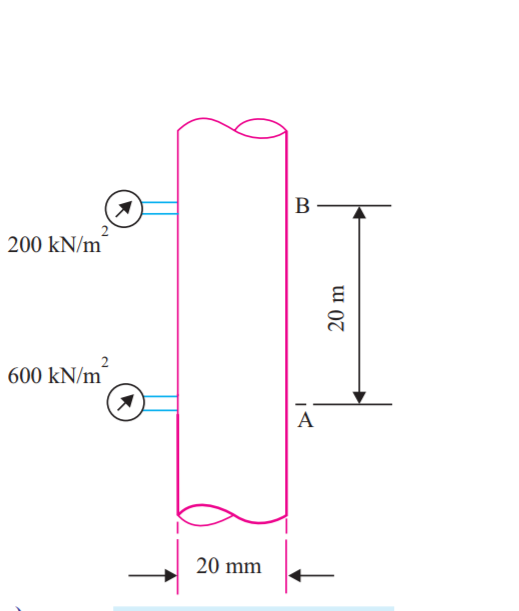
Crude oil of µ = 1.5 poise and relative density 0.9 flows through a 20 mm diameter vertical pipe. The pressure gauges fixed 20 m apart read 600 `(kN)/m^2` and `200( kN)/m^2`, as shown in Figure. Find direction and rate of flow through pipe.
Oil of specific gravity 0.82 is pumped through a horizontal pipeline 150 mm in diameter and 3 km long at rate of ` 0.015 m^3/s`. The pump has an efficiency of 68% and requires 7.5 kW to pump oil. (i) What is dynamic viscosity of oil? (ii) Is flow laminar?
A fluid of viscosity `8 `poise and specific gravity `1.2` is flowing through a circular pipe of diameter ` 100 `mm. The maximum shear stress at pipe wall is `210 N/m^2`. Find:
- The pressure gradient,
- The average velocity, and
- Reynolds number of flow.
An oil (µ = 20 cP, ρ = 1200 kg/m3) flows through a 2.5 cm I.D. pipe 250 m long.
- What is maximum flow in `m^3/s` that will ensure laminar flow ?
- What would be pressure drop for this flow?
A pipe 60 mm diameter and 450 m long slopes upwards at 1 in 50. An oil of viscosity `0.9 (Ns)/m^2` and specific gravity 0.9 is required to be pumped at rate of 5 litres/sec.
- (i) Is flow laminar?
- (ii) What pressure difference is required to attain this condition?
- (iii) What is power of pump required assuming an overall efficient of 65%?
- (iv) What is centre-line velocity and velocity gradient at pipe wall?
