Laminar Pipe Flow
Course: Hydraulics — Practice MCQs, solutions, formulas & past entrance questions.
 Guest
Chapter:
|
1. In a pipe of 300 mm diameter, maximum velocity of flow is found to be 2 m/s. If flow is laminar,find:
|
|
5. An oil (µ = 20 cP, ρ = 1200 kg/m3) flows through a 2.5 cm I.D. pipe 250 m long.
|
All Chapters
Topics
In a pipe of 300 mm diameter, maximum velocity of flow is found to be 2 m/s. If flow is laminar,find:
- average velocity and radius at which it occurs
- velocity at 50mm from wall of pipe
An oil of viscosity 9 poise and specific gravity 0.9 is flowing through a horizontal pipe of 60 mm diameter. If pressure drop in 100 m length of pipe is `1800 (kN)/m^2`, determine:
- The rate of flow of oil
- The centre line velocity
- The total frictional drag over 100 m length
- The power required to maintain flow
- The velocity gradient at pipe wall
- The velocity and shear stress at pipe wall
- The velocity and shear stress at 8mm from wall.
Oil of absolute viscosity 1.5 poise and density 848.3 kg/m3 flows through a ` 30` cm I.D. pipe. If head loss in `3000` m length of pipe is `20` m, assuming a laminar flow, determine :
- velocity,
- Reynolds number and
- friction factor (Fanningâ??s).
A fluid of density `1200 (kg)/m^3` and viscosity `0.5 `poise is flowing at a rate of `5m^3/( min)` in a circular pipe of cross-section of `1 m^2`. Is flow laminar or turbulent? Can you predict maximum velocity of fluid in pipe ?
An oil (µ = 20 cP, ρ = 1200 kg/m3) flows through a 2.5 cm I.D. pipe 250 m long.
- What is maximum flow in `m^3/s` that will ensure laminar flow ?
- What would be pressure drop for this flow?
A pipe 60 mm diameter and 450 m long slopes upwards at 1 in 50. An oil of viscosity `0.9 (Ns)/m^2` and specific gravity 0.9 is required to be pumped at rate of 5 litres/sec.
- (i) Is flow laminar?
- (ii) What pressure difference is required to attain this condition?
- (iii) What is power of pump required assuming an overall efficient of 65%?
- (iv) What is centre-line velocity and velocity gradient at pipe wall?
A liquid with a specific gravity `2.8` and a viscosity `0.8` poise flows through a smooth pipe of unknown diameter, resulting in a pressure drop of `800 N/m^2` in `2` km length of pipe. What is pipe diameter if mass flow rate is` 2500 (kg)/h`.
Crude oil of µ = 1.5 poise and relative density 0.9 flows through a 20 mm diameter vertical pipe. The pressure gauges fixed 20 m apart read 600 `(kN)/m^2` and `200( kN)/m^2`, as shown in Figure. Find direction and rate of flow through pipe.
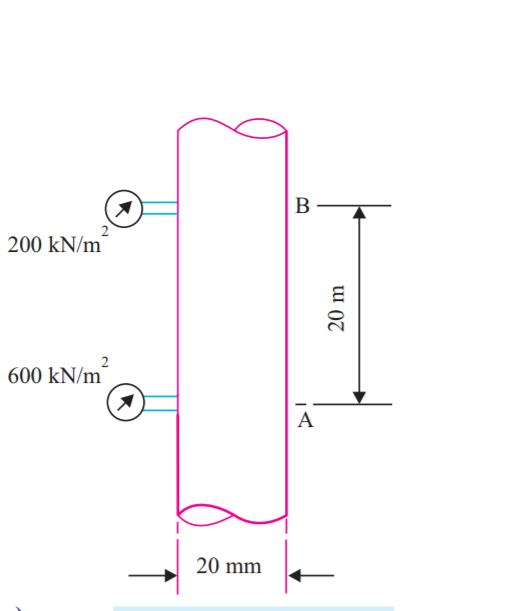
Oil of specific gravity 0.82 is pumped through a horizontal pipeline 150 mm in diameter and 3 km long at rate of ` 0.015 m^3/s`. The pump has an efficiency of 68% and requires 7.5 kW to pump oil. (i) What is dynamic viscosity of oil? (ii) Is flow laminar?
A fluid of viscosity `8 `poise and specific gravity `1.2` is flowing through a circular pipe of diameter ` 100 `mm. The maximum shear stress at pipe wall is `210 N/m^2`. Find:
- The pressure gradient,
- The average velocity, and
- Reynolds number of flow.
